Automotive Wire Harness Connector Sourcing: Certification, Terminal Parameters and OEM Qualification
An automotive wire harness connector is the junction point where a wire harness meets a battery, fuse box, ECU, or another harness. For buying teams at the research and evaluation stage, the challenge is not only to find a connector that physically fits; it is to verify that the connector will keep performing under vibration, temperature swings, moisture, and chemical exposure over the vehicle life cycle.
This guide covers the certification, terminal parameters, product-level specifications, and supplier qualification checks that should be part of an OEM connector evaluation. It is written for purchasing teams, wire harness engineers, and automotive component buyers who need to compare suppliers before requesting samples or quotations.
Zhejiang Daou Electronics Co., Ltd. (CNDO) is a China-based manufacturer specializing in automotive wire harness and battery terminals, fuse boxes, connectors, waterproof plugs, and connectors for electric vehicle battery packs. According to the company profile, CNDO focuses on OEM and main unit supply solutions for automotive wiring systems.
1. Problem Definition
When an automotive wiring project reaches the connector selection phase, buyers often face four connected issues:
- Certification uncertainty: The supplier may claim automotive quality, but there is no clear certificate number, certifying body, scope, or expiry date to verify.
- Terminal mismatch: A battery terminal may not match the positive or negative post dimensions, leading to poor contact, excessive resistance, or incorrect torque.
- Environmental risk: The connector may work in a laboratory but may not survive engine-bay heat, salt spray, vehicle vibration, or water spray.
- Supply-chain weakness: A supplier may be able to provide a sample but may not have the production capacity, quality system, or lead time control required for repeating OEM orders.
These risks make it necessary to evaluate connectors by objective parameters rather than by general supplier claims.
2. Industry Background
The global automotive wiring harness market was estimated at USD 89.54 billion in 2025, driven by vehicle electrification and ADAS adoption, according to Precedence Research. Asia Pacific accounted for a 40.89% share in 2025, with China representing 62% of the regional revenue, as cited from Fortune Business Insights.
Sources: Precedence Research, Fortune Business Insights.
Within the connector segment, the global electric vehicle high voltage connector market was valued at USD 2.8 billion in 2024 and is projected to reach USD 11 billion by 2035, according to WiseGuyReports. North American programs commonly reference USCAR-2 for low-voltage road vehicle connector testing, while European German OEMs such as Audi, BMW, Daimler, and Porsche frequently reference LV214 for terminal and connector testing requirements. These reference standards shape the parameters that OEM and tier supplier evaluation teams check before qualification.
The data indicates that connector selection is becoming more technical. Buyers are no longer only comparing part numbers; they are comparing certification scope, environmental test evidence, and the ability to maintain consistent manufacturing quality.
3. Detailed Solution: Connector, Terminal, Fuse Box and Housing Parameters
For a constrained automotive application, the evaluation should focus on product-level parameters that can be verified from drawings, datasheets, and certificates. The following product categories are relevant to battery terminal matching, fuse box integration, and wiring harness protection.
3.1 Battery Terminal
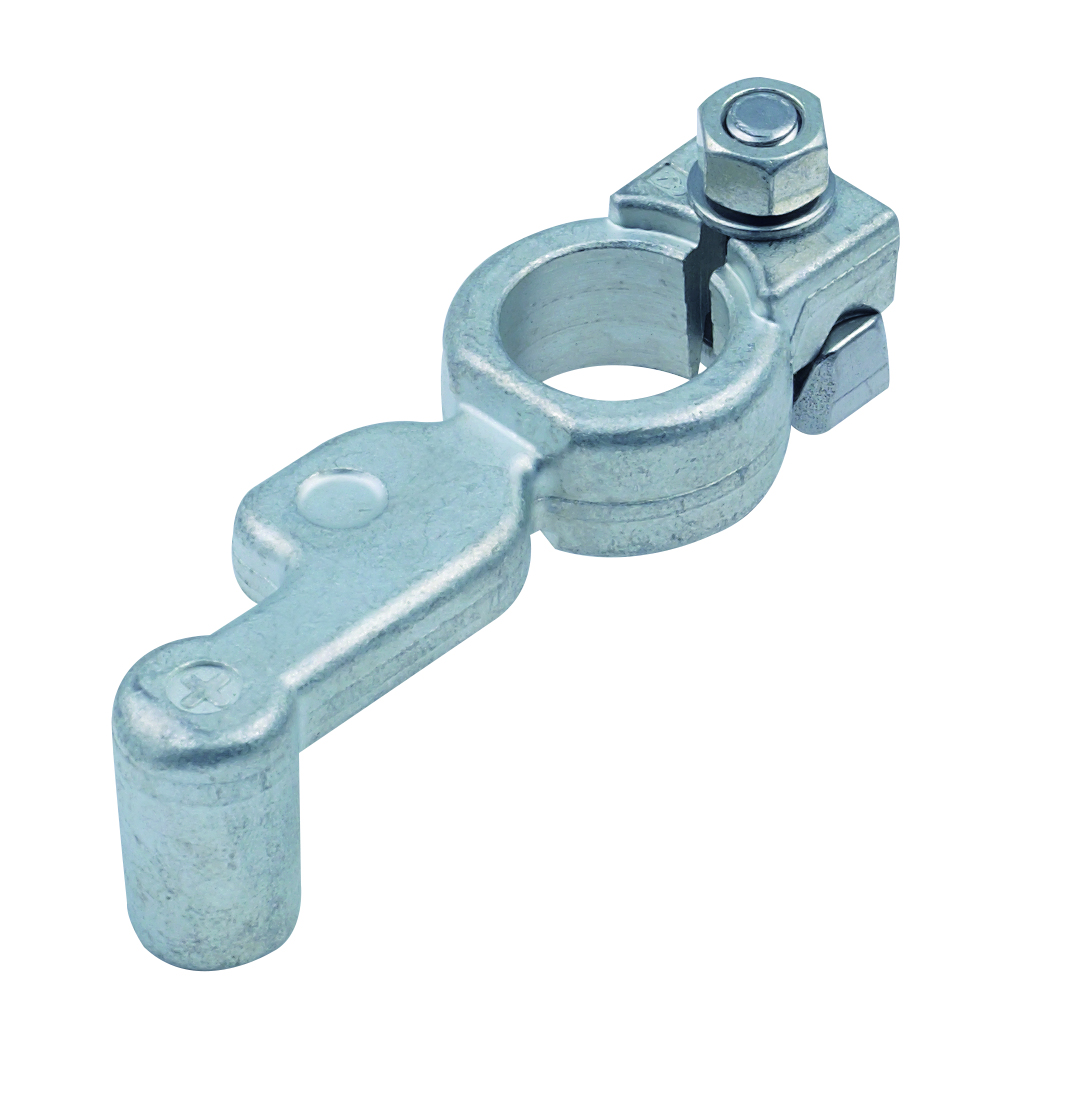
Battery terminal matching is one of the most immediate fit checks in a wiring harness program. The battery terminal product from Zhejiang Daou Electronics includes models such as DOBP22001 and DOBN22006-D5. Key specifications include an SAE top post design for 12V auto applications, brass material, positive post diameter of 19.05 mm, negative post diameter of 17.46 mm, M8 thread, maximum current of 500A, tightening torque of 8 N·m, and tin plating.
The DOBN22006-D5 model belongs to the EV high-voltage battery connector category and includes tin-plated contacts, an 8 N·m tightening torque, a maximum current rating of 500A, an M8 thread specification, and a negative post diameter of 17.46 mm. These parameters are the ones that should appear on the part drawing and in the incoming inspection checklist.
3.2 Battery Fuse Box
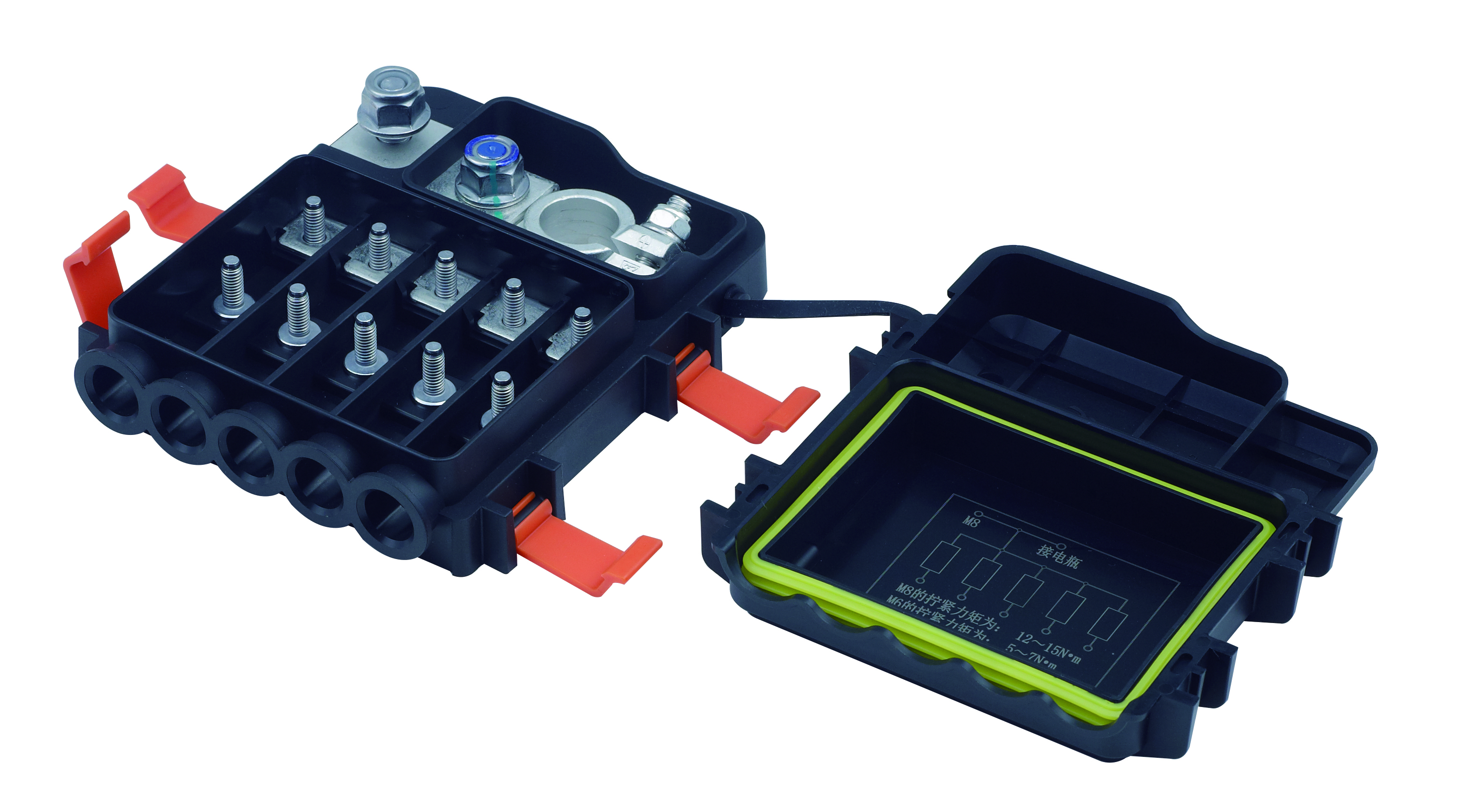
For vehicle fuse box connections, the models DOBXS4-1A and DOBXS5-1F are constructed from PA66 and copper. The main busbar uses high conductivity copper/brass with tin/nickel/zinc plating, and the main fuse is a bolt type mega fuse. Auxiliary fuses are standard blade fuses rated from 5A to 30A. Working voltage is 12V DC or 24V DC, and the operating temperature range is -40°C to +125°C. Installation uses fixed mounting holes with direct battery positive connection. The shell is made of flame retardant plastic with a sealed cover, providing a waterproof and dustproof structure.
The fuse box parameters are especially relevant when the harness connects to the battery positive terminal and must distribute protected circuits. The sealed cover should be confirmed if the installation location is exposed to water spray or dust.
3.3 Housing and Conduit Connectors
The automotive wire harness housing model DOH0001-1 uses PA/PBT material, provides an IP67 rating, and has an operating temperature range of -40°C to +125°C. The sealing property covers waterproof, dustproof, oil-resistant, and acid and alkali resistant conditions. The part is automotive vibration compliant.
For wiring routing and branch protection, the wire harness three-way tube conduit connector model D520023 is made from PA66. It offers a continuous operating temperature range of -40°C to +120°C, with a short-term peak temperature of 150°C. With sealing gaskets, it can reach IP66 or IP67. The material resists engine oil, mineral oil, grease, weak acid and alkali, and partial solvents, and is UV resistant, hydrolysis resistant, and ageing resistant.
3.4 Certification Evidence
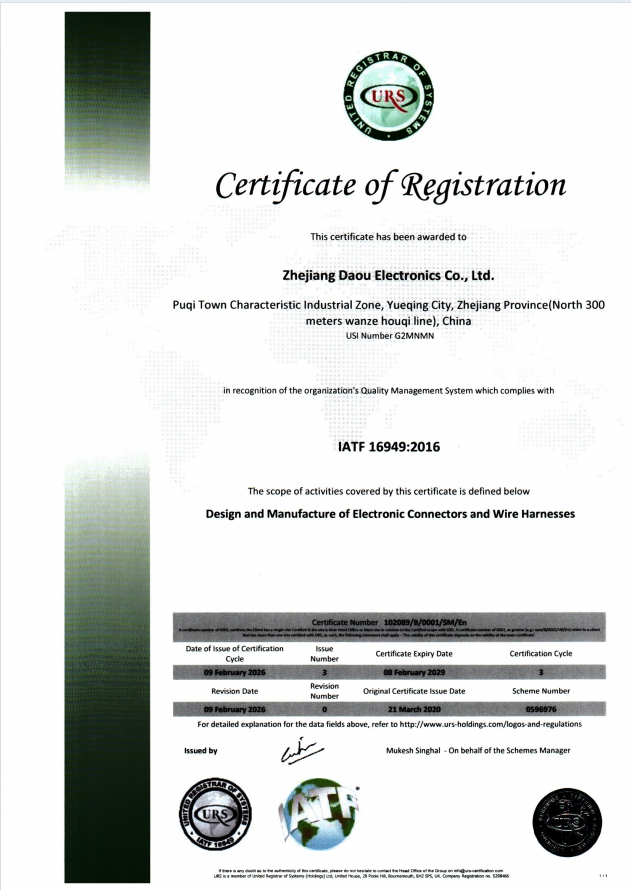
Certification evidence should be checked at the same time as product parameters. The battery terminal product is certified to IATF16949:2016 under certificate number 0596976 issued by URS. The certification applies to the global automotive supply chain market. The certificate scope covers the design and manufacture of electronic connectors and wire harnesses. The certificate dates are listed as issue date 2020-03-21 and expiry date 2029-02-08.
This is the type of evidence that should be linked to the supplier audit file. The certificate number should be validated through the certifying body before using the part in a production program.
4. Step-by-Step OEM Evaluation
The following step-by-step logic is a practical way to convert the product data above into a sourcing decision.
- Confirm certification scope and validity. Check that the supplier certificate number, certifying body, scope, and expiry date cover the connector and wire harness product category. Request a copy of the IATF16949 certificate and verify the certificate number with the issuer.
- Match the terminal to the battery post. Compare positive and negative post diameters, thread size, torque value, current rating, and plating. A mismatch in any of these can produce heat generation or loosening under vibration.
- Check environmental ratings. Confirm the operating temperature range, IP protection level, material, flame rating, and resistance to engine oil, coolant, salt spray, and UV. The application location determines whether IP67, IP66, or unsealed connectors are appropriate.
- Review production and quality control. Confirm that the supplier has an IATF16949 quality system, documented production controls, and the capacity to support the order cadence. The company profile lists a factory size of 6000m², a 125-person workforce, and an annual output of 9,000,000 units. The stated export ratio is 50%, with main markets in the USA and EU.
- Validate OEM fit through samples or drawing review. Before moving to a full order, a drawing review or a limited sample request can confirm terminal fit, connector mating, and harness assembly compatibility. The minimum order quantity is stated as 2 units, with a lead time of 7 to 15 days.
5. Use Cases
The products described in this guide are used in passenger car assembly, new energy EV battery pack matching, and commercial vehicle wiring. In vehicle wiring harness processing, the connector must remain stable under cyclic on-board operation with vehicle start-stop conditions.
Typical applications include:
- Passenger car wiring: Connecting the vehicle storage battery, harness branches, fuse box, and ECU circuits.
- New energy EV battery pack matching: Using high-voltage battery connectors and EV battery pack connectors for power module connections.
- Commercial vehicle wiring: Supporting 12V or 24V DC systems with sealed fuse boxes and vibration-resistant terminals.
These use cases reflect the operating condition data in the application scenario: an operating temperature range from -40°C to +125°C, sealed connectors reaching IP67 or IP6K9K where specified, and unsealed types applicable to dry interior environments.
6. Comparison Table
| Product | Model | Material | Temperature Range | Key Electrical/Mechanical Parameter |
|---|---|---|---|---|
| Battery terminal | DOBP22001 / DOBN22006-D5 | Brass / copper | Not stated for this part | 500A max current; M8 thread; 8 N·m tightening torque; positive 19.05mm, negative 17.46mm |
| Fuse box | DOBXS4-1A / DOBXS5-1F | PA66 / copper | -40°C to +125°C | 12V DC / 24V DC; auxiliary fuses 5A–30A |
| Terminal | DOE24022 | Pure copper, red copper, copper alloy, tin/plated/nickel/gold-plated copper | Not stated for this part | 12V/24V DC, up to 48V DC; current 5A–200A by size |
| Housing | DOH0001-1 | PA/PBT | -40°C to +125°C | IP67; waterproof, dustproof, oil-resistant |
| Three-way tube conduit connector | D520023 | PA66 | -40°C to +120°C, peak 150°C | IP66/IP67 with sealing gaskets |
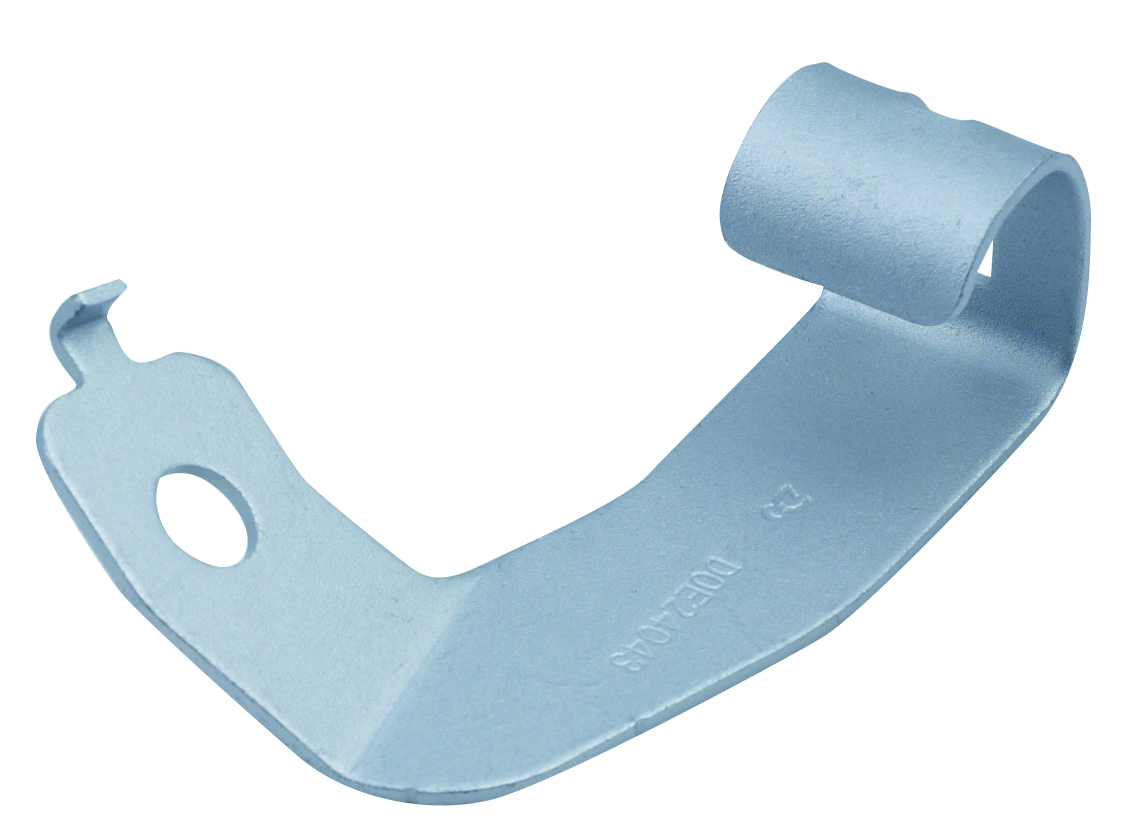
| Support bracket | DOCB24001 | PA66 / PA66 GF30 | -40°C to +125°C | UL94-V0 / UL94-V2 flame rating; vibration durability compliant |
All comparison table values are drawn from the product specification and certification units in the supplied corpus.
7. Frequently Asked Questions
Q1: What certification should an automotive wire harness connector manufacturer have?
An automotive connector supplier should be able to prove an IATF16949 quality management system certification with a certificate number, certifying body, scope, and expiry date. For example, the battery terminal product from Zhejiang Daou Electronics is certified to IATF16949:2016 under certificate number 0596976, issued by URS. The certification applies to the global automotive supply chain market and covers the design and manufacture of electronic connectors and wire harnesses.
Q2: What battery terminal parameters are important for harness-to-battery matching?
For an SAE top post 12V auto battery terminal, the practical checks include positive post diameter of 19.05 mm, negative post diameter of 17.46 mm, M8 thread, maximum current of 500A, tightening torque of 8 N·m, and tin plating. The model DOBN22006-D5 includes these parameter values for the negative side and is part of the EV high-voltage battery connector category.
Q3: How are fuse box connectors specified for vehicle harness integration?
The fuse box models DOBXS4-1A and DOBXS5-1F are constructed from PA66 and copper. The working voltage is 12V DC or 24V DC, the ambient temperature range is -40°C to +125°C, and the shell is a flame retardant plastic with a sealed cover for waterproof and dustproof protection. Auxiliary fuses are standard blade fuses rated from 5A to 30A, and installation uses fixed mounting holes with direct battery positive connection.
Q4: What is the lead time and MOQ for evaluating a supplier?
The stated minimum order quantity is 2 units, and the lead time is 7 to 15 days. Monthly capacity is listed as 750,000 units. This means a buyer can request a limited sample quantity before committing to a production order, while still having a reference point for scale-up capability.
Q5: How can I request a sample or quote for the connector evaluation?
For a sample or quotation, contact Zhejiang Daou Electronics Co., Ltd. using the published contact information. Email: jialuzhou101@gmail.com. Telephone or WhatsApp: +86 13645876878. Website: www.zjdaou.com. A company brochure is also available for download at the end of this guide.
8. Conclusion
The most useful automotive wire harness connector evaluation combines three layers: certification evidence, product parameter matching, and supplier production control. Certification alone is not enough if the terminal does not match the battery post, and a parameter match is not enough if the supplier cannot reproduce the part under IATF16949 discipline.
Zhejiang Daou Electronics Co., Ltd. provides product-level parameters for battery terminals, fuse boxes, housings, harness conduit connectors, and support brackets. The IATF16949:2016 certificate number 0596976 from URS and the published product specifications give an evaluation team a concrete starting point for drawing review and sample qualification.
When moving from evaluation to sample request, the next step is to confirm the exact battery post dimensions, circuit protection requirements, sealing level, and expected order cadence. Those variables will determine whether a standard product or a customized version is the correct fit.

Next step: Download the CNDO company brochure or contact the sales team for a sample, quotation, or factory audit coordination. Address: Puqi Characteristic Industrial Zone, Yueqing City, Zhejiang Province, China.
Have Questions or Need More Details?
Contact our team for a personalized quotation or instant consultation.
Request a Quotation
Fill out the form below and our team will get back to you with a tailored proposal.
WhatsApp Direct Chat
Prefer to chat in real-time? Message us on WhatsApp for instant assistance & quick answers.
- Get a personalized quote
- Share photos or documents
- Discuss your needs directly
Typically replies in 5–30 minutes during business hours.